
Search
In a sunny country such as Australia, it’s important to identify how to achieve the right amount of sun exposure for good health. We need to be able to harness the benefits of vitamin D and sunlight while remaining protected from the proven dangers of too much UV radiation.
Discover more about Telethon Kids Institute research.
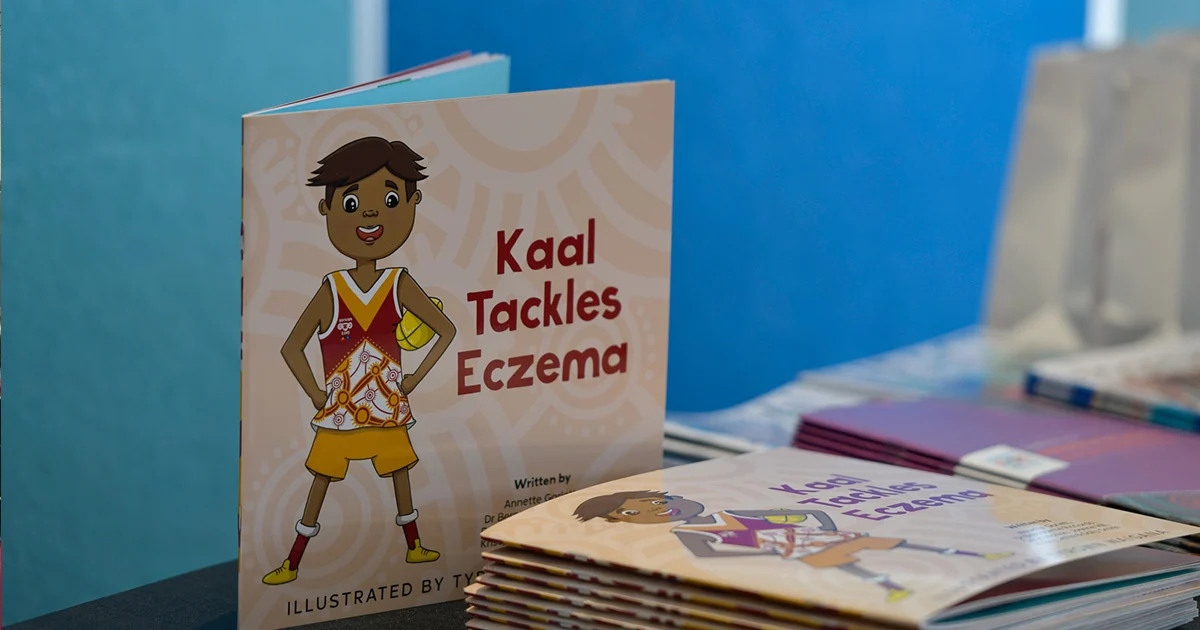
In close partnership with Aboriginal Elders and community members in Western Australia's south-west, we created ‘Kaal Tackles Eczema’, a children’s book to help Aboriginal families manage eczema. Our research showed a high prevalence and need for culturally relevant resources. The book uses Noongar language and art to educate and reduce infections, and is available online and in schools.
This study described the presenting features, initial assessment, hospital care, and complications at discharge among Australian adolescents and young adults with Invasive meningococcal disease.
During winter months of temperate regions, concurrent epidemics of multiple respiratory pathogens can occur, causing periods of increased clinical burden. Case time series, which are predominantly used to monitor infection levels, can exhibit substantial noise and day-of-the-week effects, limiting the visual interpretation of trends in raw data.
The transition to formal schooling is a critical milestone in a child’s development. For Aboriginal children, early experiences are shaped by both cultural strengths and enduring impacts of colonisation. This study explored factors influencing Aboriginal families’ transition-to-school experiences in an urban Western Australian community.
When doctors working within healthcare systems under pressure perpetrate, witness, or fail to prevent acts that contradict their own moral or ethical values and expectations, it can lead to moral distress or moral injury. This can result from active behaviour and from purposeful inactive behaviour. It is a growing and critical concern, representing significant distress that extends far beyond traditional concepts such as burnout. This article discusses moral injury in clinical and academic medicine and actively gives suggestions to prevent and address moral injury.
Pediatric perioperative care can be described as a journey, starting when surgery is first contemplated, all the way through to a patient’s full recovery. For the child and their family, this journey spans from the time at home pre-operatively through a hospital stay and finishes with at-home recovery.
A main challenge identified by youth during exercise and sport is the lack of knowledge and awareness around type 1 diabetes (T1D) particularly in community sport settings. Working with youth living with T1D, parents and community sport coaches, our team has developed resources for the T1D and sporting community. This study was to evaluate the acceptability and usability of the resources.
Timo Lassmann BSc (Hons) MSc PhD Feilman Fellow; Head, Precision Health Research and Head, Translational Intelligence timo.lassmann@thekids.org.au