
Search
The measurement of quality of life (QOL) in children with intellectual disability often relies upon proxy report via caregivers. The current study investigated whether caregiver psychological distress mediates or moderates the effects of impairment on their ratings of QOL in children with intellectual disability.
Several researchers have hypothesised that individuals with Autism Spectrum Disorder (ASD) show encoding delays in their obligatory event-related potentials (ERPs)/ event-related fields (ERFs) for low-level auditory information compared to neurotypical (NT) samples. However, empirical research has yielded varied findings, such as low-level auditory processing in ASD samples being unimpaired, superior, or impaired compared to NT samples. Diverse outcomes have also been reported for studies investigating ASD-NT differences in functional lateralisation of delays.
The aim of this study was to understand the challenges experienced by families obtaining a diagnosis and therapy for developmental coordination disorder (DCD). Parents of 435 children aged 4-18 years with persistent motor difficulties consistent with a diagnosis of DCD completed an online survey. Diagnostic timeline and diagnostic label/s received were examined, along with therapies accessed.

Director of CliniKids, Professor Andrew Whitehouse, and Professor Murray Maybery, have been identified as the world’s most frequent autism research collaborators of the decade.
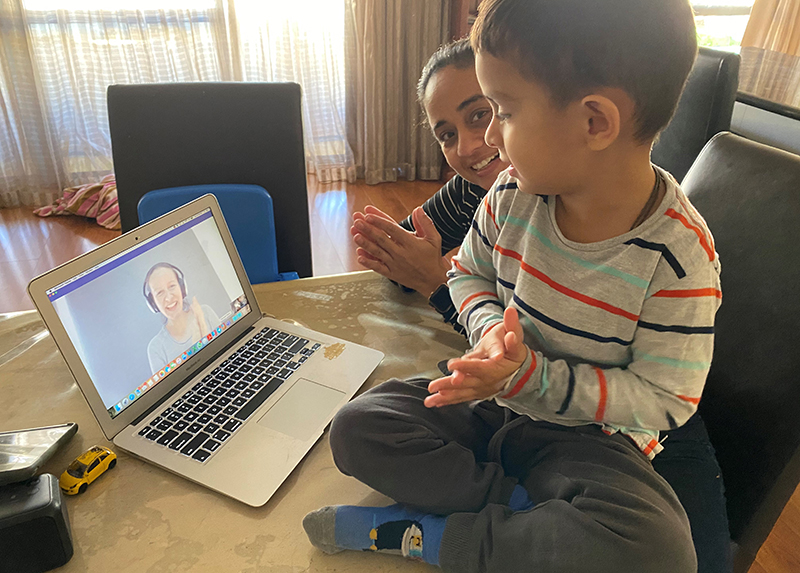
The CliniKids team has reimagined how allied health services for children with autism spectrum disorder or developmental delays are delivered.
Natural Language Sampling (NLS) offers clear potential for communication and language assessment, where other data might be difficult to interpret. We leveraged existing primary data for 18-month-olds showing early signs of autism, to examine the reliability and concurrent construct validity of NLS-derived measures coded from video-of child language, parent linguistic input, and dyadic balance of communicative interaction-against standardised assessment scores. Using Systematic Analysis of Language Transcripts (SALT) software and coding conventions, masked coders achieved good-to-excellent inter-rater agreement across all measures.
Anxiety commonly co-occurs in autism. Exploring and understanding potential underpinning mechanisms contributing to and maintaining anxiety in the early years is important in managing anxiety. Intolerance of uncertainty (IU), a tendency to find uncertainty difficult, is a transdiagnostic mechanism contributing to anxiety, but little is known about how IU may be experienced in young children on the autism spectrum. This study investigated parental perspectives of children's experiences of uncertainty.
The growing global prevalence of autism spectrum disorder is associated with increasing costs for support services. Ascertaining the effects of a successful preemptive intervention for infants showing early behavioral signs of autism on human services budgets is highly policy relevant.
The Repetitive Behaviours Questionnaire for Adults (RBQ-2A) measures two factors of restricted and repetitive behaviours (RRBs) associated with autism. However, the Diagnostic and Statistical Manual of Mental Disorders (DSM-5) provides four criteria for RRBs: repetitive motor behaviours, insistence on sameness, restricted interests, and interest in sensory aspects of the environment (or atypical sensitivity).
Recent studies have reported that strengths-based programs, leveraging autistic adolescents' abilities and interests, could improve their skills and facilitate social engagement. However, little is known about the long-term impact of strengths-based approaches. This study aimed to explore the long-term outcomes of community strengths-based programs designed to support autistic adolescents in developing interests and skills in Science, Technology, Engineering, Arts, and Mathematics (STEAM) and the factors influencing their participation in these programs.