
Search
Showing results for "early life"
In Western Australia (WA), children aged 24 months living regionally or remotely (non-urban) have suboptimal vaccine uptake. As there has not yet been a systematic approach to understanding the facilitators and barriers to childhood vaccination in regional and remote WA, this study aimed to understand the views of key immunisation stakeholders regarding barriers and solutions.
Concerns regarding adverse events following immunisation are a barrier to vaccine uptake. Health professionals use vaccine safety surveillance systems (VSSS) to monitor vaccines and inform the public of safety data. With little known about public attitudes, perceptions, and experiences with VSSS, we examined them in the context of COVID-19 vaccinations in Western Australia.
We collected information on a monthly basis on the patterns of seizures and medications of 162 girls in the Australian Rett Syndrome study over a calendar year.
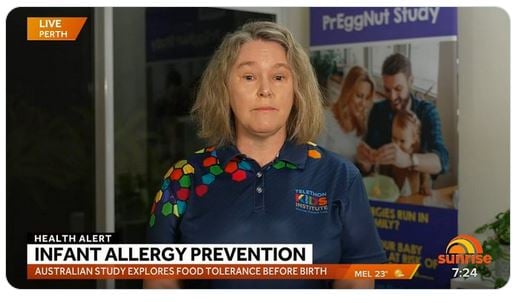
Dr Debbie Palmer spoke to Ch7 Sunrise about the changing advice for parents about the development of food allergies in kids.

ORIGINS has recently welcomed its 4,000th family into the study.
High frequency ventilation (HFV) in neonates has been in use for over forty years. Some early HFV ventilators are no longer available, but high frequency oscillatory ventilation (HFOV) and jet ventilators (HFJV) continue to be commonly employed. Advanced HFOV models available outside of the United States are much quieter and easier to use, and are available as options on many conventional ventilators, providing important improvements such as tidal volume measurement and targeting.
Concerns regarding adverse events following immunisation are a barrier to vaccine uptake. Health professionals use vaccine safety surveillance systems (VSSSs) to monitor vaccines and inform the public of safety data. With little known about public attitudes, perceptions, and experiences with VSSS, we examined them in the context of COVID-19 vaccinations in Western Australia.
Cells undergo a major epigenome reconfiguration when reprogrammed to human induced pluripotent stem cells (hiPS cells). However, the epigenomes of hiPS cells and human embryonic stem (hES) cells differ significantly, which affects hiPS cell function. These differences include epigenetic memory and aberrations that emerge during reprogramming, for which the mechanisms remain unknown.
Since the emergence of SARS-CoV-2 in 2019 through to mid-2021, much of the Australian population lived in a COVID-19-free environment. This followed the broadly successful implementation of a strong suppression strategy, including international border closures. With the availability of COVID-19 vaccines in early 2021, the national government sought to transition from a state of minimal incidence and strong suppression activities to one of high vaccine coverage and reduced restrictions but with still-manageable transmission.
Young people who have had contact with the criminal justice system are at increased risk of early death, especially from injuries. However, deaths due to non-communicable diseases (NCDs) in this population remain poorly described. We aimed to estimate mortality due to NCDs in people with a history of involvement with the youth justice system, compare NCD mortality rates in this population with those in the general population, and characterise demographic and justice-related factors associated with deaths caused by NCDs in people with a history of contact with the youth justice system.