
Search
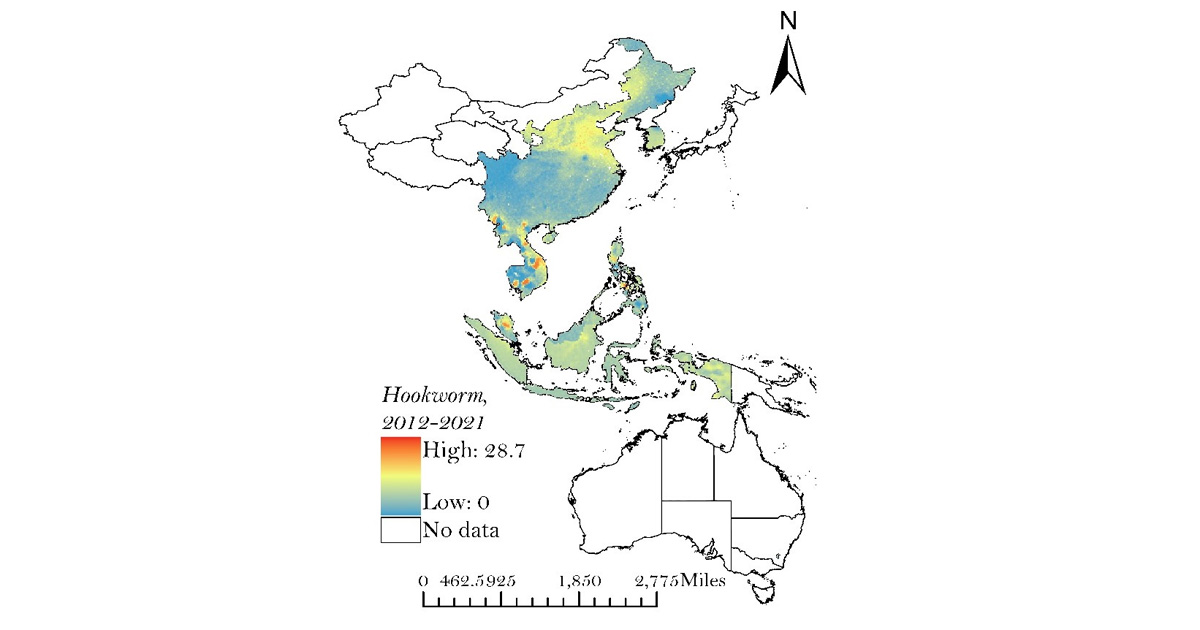
A global research team led by geospatial modelling experts from The Kids Research Institute Australia and Curtin University has provided the first detailed maps identifying hotspots across the Western Pacific Region where debilitating parasitic worms are rife.
Globally, tuberculosis (TB) is the leading infectious cause of morbidity and mortality, with the risk of infection affected by both individual and ecological-level factors. While systematic reviews on individual-level factors exist, there are currently limited studies examining ecological-level factors associated with TB incidence and mortality. This study was conducted to identify ecological factors associated with TB incidence and mortality.
Cancer prevention and care efforts have been challenged by the COVID-19 pandemic and armed conflicts, resulting in a decline in the global Human Development Index (HDI), particularly in low- and middle-income countries. These challenges and subsequent shifts in health care priorities underscore the need to continuously monitor cancer outcome disparities and statistics globally to ensure delivery of equitable and optimal cancer prevention and care in uncertain times.
Drug-resistant tuberculosis (DR-TB) is a significant public health concern, often resulting in poor treatment outcomes. This study aims to identify predictors of poor treatment outcomes among patients with DR-TB in Hunan Province, China.
The carcinogenic liver fluke Opisthorchis viverrini is a major public health problem in the Mekong basin region. The liver flukes can induce cholangiocarcinoma, a bile duct cancer that causes a significant burden of mortality and economic loss. Various public health interventions have been conducted to reduce opisthorchiasis but the prevalence of O. viverrini remains high in endemic regions.
Interferon γ release assays (IGRAs) are widely used for diagnosis of latent tuberculosis infection. However, with repeated testing, IGRA transformation (conversion or reversion) may be detected and is challenging to interpret. We reviewed the frequency of and risk factors for IGRA transformation.
Low tuberculosis (TB) case detection remains a major challenge in achieving the End TB targets. New strategies that consider local contexts are needed in countries with high TB burdens like Ethiopia. This study examined the effect of integrating traditional and modern TB care to increase the TB case detection rate.
Traditional birth attendance (TBA) remains common in Sub-Saharan Africa (SSA), impacting maternal and neonatal mortality rates. This study aimed at producing high-resolution geospatial estimates and identifying predictors of TBA-assisted childbirth in SSA.
Despite high levels of global concern, little is known about the epidemiology of Clostridioides (Clostridium) difficile infection (CDI) in Cambodia. This study aimed to identify the prevalence and risk factors for CDI, and molecular types of C. difficile in hospitalized adults at Calmette Hospital, Phnom Penh, Cambodia.
Kefyalew Alene BSc, MPH, PhD Head, Geospatial and Tuberculosis 0404705064 Kefyalew.alene@thekids.org.au Honorary Research Fellow Dr Kefyalew Alene